
Umrah is a beautiful pilgrimage to the Sacred Mosque in Makkah that can be performed at any time of the year. Unlike Hajj, it is not limited to specific dates. For many Muslim women, Umrah is a deeply personal journey to draw closer to Allah, seek forgiveness, and renew the heart.
In our 2025 survey of 250 UK Muslim women who travelled for Umrah, the three most common reasons for going were:
| Reason | % of women |
|---|---|
| Spiritual renewal and drawing closer to Allah | 27% |
| Seeking forgiveness | 31% |
| Personal milestone or lifelong dream | 39% |
This guide is based on the questions and concerns real women have before travelling for Umrah, especially those coming from the UK.
Do women need a mahram for Umrah?
This is one of the most common questions women ask before booking.
The short answer is that most scholars traditionally say a woman should travel with a mahram, such as her husband, father, son, brother, or another permanently unmarriageable male relative. At the same time, current Saudi rules allow women to perform Umrah without a mahram. The UK also does not prevent women from travelling independently.
There are three points to keep in mind:
1. The classical scholarly view
The majority of scholars in the Hanafi, Shafi’i, Hanbali, and Maliki schools have held that a mahram is required for long-distance travel.
2. Current Saudi policy
Saudi Arabia currently allows women to perform Umrah without a mahram.
3. Your own decision
If you are unsure, speak to a trusted local scholar or your mosque before you book. It is also wise to check the latest visa and travel rules before departure.

Women’s ihram rules
Understanding ihram is one of the most important parts of Umrah. For women, the rules are different from men’s rules in several key ways.
Ihram clothing for women
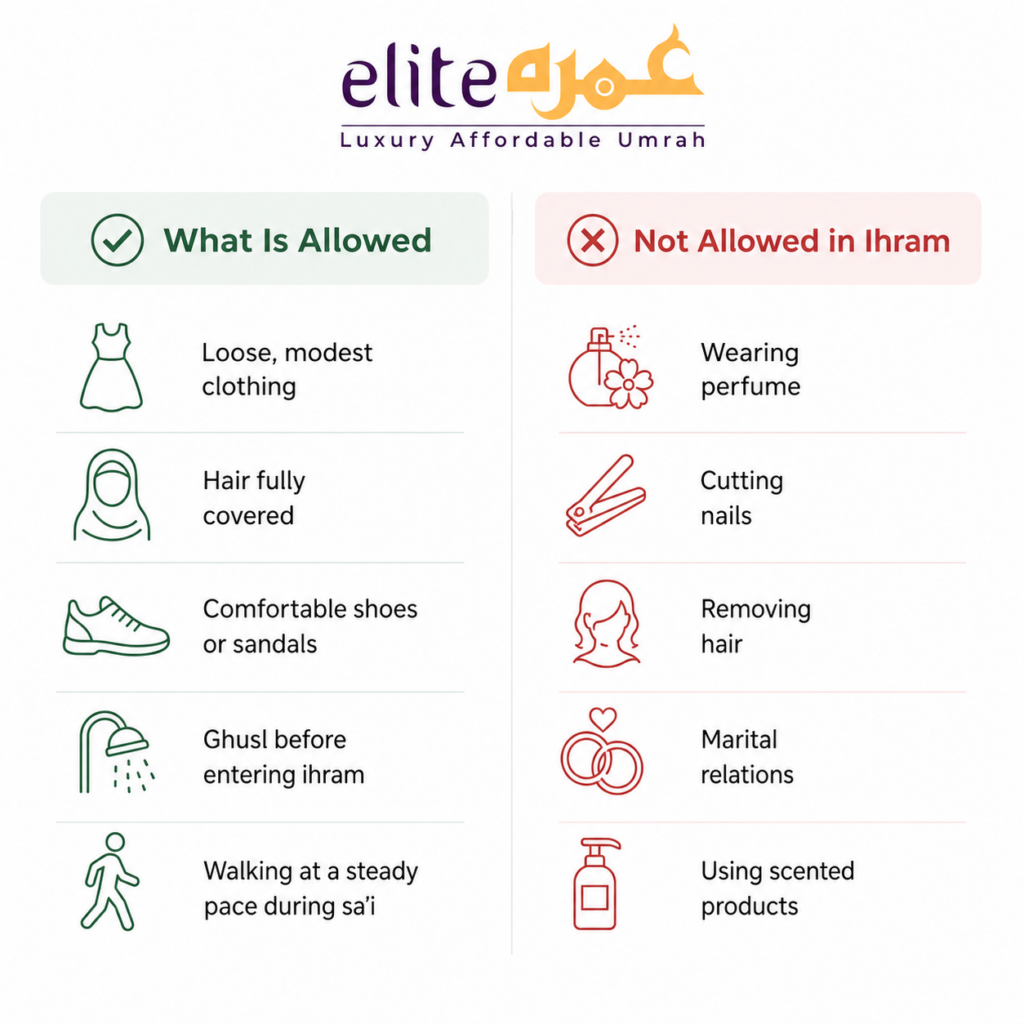
Women do not have a specific ihram uniform. You can wear ordinary loose and modest clothing. A simple abaya or a long loose dress is ideal.
Keep in mind:
- Clothing should be opaque and not see-through
- Light colours can help in the heat
- Hair should be fully covered with a headscarf
- If you wear a face covering, it should not rest directly on the face during ihram
Footwear
Women may wear comfortable shoes, sandals, or slippers. There is no requirement for women to expose the ankle or the top of the foot. Choose footwear that is supportive and already broken in, as you will do a lot of walking.
What is not allowed in ihram
While in ihram, both men and women should avoid:
- perfume
- cutting nails
- removing hair
- marital relations
Women should also keep their hair covered throughout the pilgrimage.
Ghusl before ihram
It is recommended to take ghusl before entering ihram. You can also trim your nails and remove unwanted hair beforehand. This is sunnah, so if you are short on time, do not panic.
Step-by-step Umrah for women
Here is the full process of Umrah in order, for women.
1. Enter ihram at the miqat
Make your intention for Umrah and begin reciting the talbiyah:
Labbaik Allahumma Labbaik, Labbaik laa shareeka laka Labbaik, Innal-hamda wan-ni’mata laka wal-mulk, laa shareeka lak.
2. Perform tawaf
Walk seven full circuits around the Kaaba, keeping the Kaaba on your left side.
After tawaf, pray two rak’ahs if you are able to do so. This can be near Maqam Ibrahim or anywhere in the mosque.
3. Drink Zamzam
After tawaf, drink Zamzam water and make dua.
4. Perform sa’i
Walk seven times between Safa and Marwah.
5. Cut your hair
To complete your Umrah, trim at least a fingertip length, around 2 cm, from the ends of your hair.
Helpful tips for women during Umrah
- Walk at a steady pace. Women do not need to run between the green lights during sa’i
- Stay close to your group or mahram
- If the ground floor is very crowded, use the upper levels for tawaf where it is often calmer
- Keep water with you and take breaks if needed
How long does Umrah take for Women?
On a normal day, the full Umrah usually takes around 2 to 4 hours. In busy seasons, it can take longer. Tawaf alone may take anywhere from 40 minutes to 1.5 hours depending on crowd levels.
Our survey found that UK women spent an average of 50 minutes completing their Umrah rites.
Umrah during your period
This is one of the most important topics for women, yet many barely explain it.
A woman cannot perform tawaf while menstruating. Tawaf must be delayed until the period has ended and purity has been regained.
What to do if your period starts
- If your period begins before Umrah, wait until it ends, then complete tawaf and continue the rest of Umrah
- If your period starts after tawaf, your Umrah is valid
- During your period, you can make dua, do dhikr, and listen to Quran
- You should wait until you are pure before praying the two rak’ahs after tawaf
It is a good idea to leave 1 or 2 extra days in your itinerary in case this affects your plans.
Our data shows that 24% of UK women had their tawaf timing affected by their period.
If your case is more specific or complicated, speak to a trusted scholar for personal guidance.
What to pack for Umrah as a woman
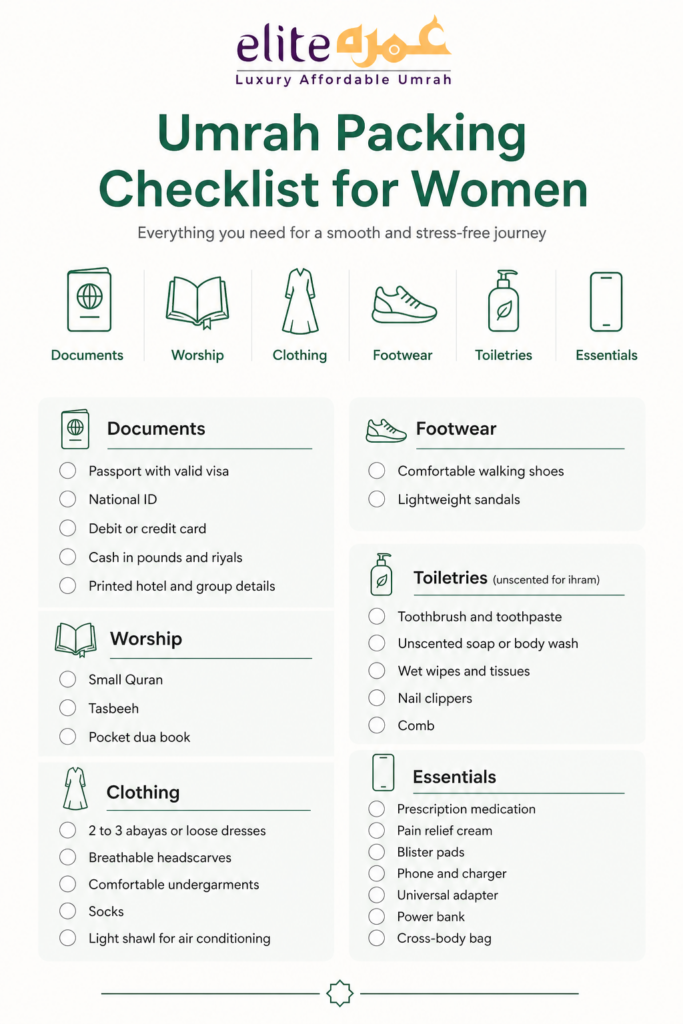
A good packing list can make your trip much easier. Here is a practical checklist based on what women actually use.
Documents and money
- Passport with valid visa
- National ID
- Debit or credit card
- Some cash in pounds and Saudi riyals
- Printed hotel details
Worship essentials
- Tasbeeh
- Pocket dua book
Clothing
- 2 to 3 abayas or loose dresses in breathable fabric
- Around 2 headscarves per day if you want regular changes
- Comfortable undergarments
- Several pairs of socks
Footwear
- 1 pair of comfortable walking shoes or trainers
- 1 pair of lightweight sandals or flip-flops
Toiletries
Use unscented products while in ihram.
- Toothbrush and toothpaste
- Unscented soap or body wash
- Wet wipes and tissues
- Nail clippers
- Comb
Health items
- Prescription medication in original packaging
- Pain relief cream or balm
- Plasters and blister pads
- Unscented hand sanitiser
Tech
- Smartphone
- Charger
- Universal plug adapter
- Power bank
Bags
- Lightweight cross-body bag
- Small backpack
- Zip pouch for documents and money
Safety, health, and etiquette for women in Makkah and Madinah
Staying safe
- Share your hotel details and contact numbers with family before you travel
- Keep valuables in a secure pouch under your abaya
- Avoid walking alone late at night
- Store your passport and spare cash in the hotel safe
Looking after your health
- Drink plenty of water and Zamzam
- Keep snacks like dates, nuts, or fruit with you
- Rest when needed, especially in hot weather
- If you feel unwell, stop and ask for help
Good etiquette
- Speak gently and be patient
- Make space for elderly pilgrims
- Keep your surroundings clean
- Remember that kindness is part of the worship
Advice for elderly women and first-timers
- Arrange wheelchair or mobility support if needed
- If your budget allows, choose a hotel close to the Haram
- Consider doing tawaf on the upper floors if crowds feel overwhelming
Your checklist before you fly
- Confirm your passport and visa
- Finalise flights, hotel, and transfers
- Speak to your doctor if you are pregnant or on medication
- Review the Umrah steps with a trusted guide or scholar
- Try on your clothing and break in your shoes
- Download Quran, dua apps, and offline maps
- Leave 1 or 2 buffer days in your plans if possible


 By:
By: